Tag Archives: History

Top 10 Famous & Deadly Swords

The first sword appeared during the Bronze Age.  It was made of copper and was uncovered at the Harappan sites in present-day Pakistan.  By the Middle Ages iron and steel swords were being mass produced and used in battle.  Soldiers were trained in swordsmanship and prepared for combat.  It was before the era of guns and high powered artillery and face to face fighting was the norm.  During this time in history, all of the royal generals, kings, and emperors owned personal swords.  These weapons were manufactured by the greatest sword makers of the time.  Many historical manuscripts document events surrounding significant swords.  This article will be examining ten world famous swords that still survive today.  Mythological and legendary swords will not be listed.

10.  Tomoyuki Yamashita’s Sword

Tomoyuki Yamashita was a general of the Japanese Imperial Army during World War II.  He became known during the war after conquering the British colonies of Malaya and Singapore, ultimately earning the nickname “The Tiger of Malaya.”  After the end of World War II, Yamashita was tried for war crimes relating to the Manila Massacre and many other atrocities in the Philippines and Singapore.  It was a controversial trial that ended with a death sentence for Tomoyuki Yamashita.  The case changed the United States rules in regards to command responsibility for war crimes, creating a law known as the Yamashita Standard.

YamashitasSword 560x297

The Sword

During his military career, Tomoyuki Yamashita owned a personal sword that contained a blade manufactured by famous sword maker Fujiwara Kanenaga sometime between 1640 and 1680.  The weapon had its handle remade in the early 1900s.  The Samurai sword was surrendered by General Yamashita, along with his army, on September 2, 1945.  It was taken by General MacArthur and given to the West Point Military Museum where it remains today.  The sword is one piece in a great collection of military arms housed at the West Point Museum.

9.  Curved Saber of San Martin

José de San Martín was a famous Argentine general that lived from 1778-1850.  He was the primary leader of the southern part of South America’s struggle for independence from Spain.  San Martín is a South American hero and the 1st Protector of Perú.  Under the lead of San Martín, Peruvian independence was officially declared on July 28, 1821.  In the state of Argentina, the Order of the Liberator General San Martin is the highest decoration given out.

Curved Saber

The Sword

One of the most cherished possessions of José de San Martín was a curved sword that he purchased in London.  San Martín admired the saber’s curved blade and felt that the weapon was maneuverable and ideal for battle.  For this reason, he armed his cavalries of granaderos with similar weapons, which he deemed important for charge attacks.  The curved sword stayed with San Martín until his death and was then passed down to the General de la Republica Argentina, Don Juan Manuel de Rosas.

In his will San Martín referred to the sword as “The saber that has accompanied me throughout the War of Independence of South America.”  In 1896 the weapon was sent to the National Historical Museum in Buenos Aires where it remains today.  In the 1960s the sword was stolen on two separate occasions and this caused museum operators to build a screened gazebo to protect the artifact.

8.  Seven-Branched Sword

The Baekje Dynasty was an ancient kingdom located in southwest Korea.  At its peak in the 4th century, Baekje controlled colonies in China and most of the western Korean Peninsula.  They were one of the Three Kingdoms of Korea, together with Goguryeo and Silla.  In 372, King Geunchogo of Baekje paid tribute to Eastern Jin and it is believed that a Seven-Branched Sword was created and given to the king as a sign of praise.

Seven Branched 300x400

The Sword

The weapon is a 74.9 cm long iron sword with six branch-like protrusions along the central blade, which is 65.5 cm.  The sword was developed for ceremonial purposes and was not built for battle.  In 1870 a Shinto priest named Masatomo Kan discovered two inscriptions on the Seven-Branched Sword.  One of them states “At noon on the sixteenth day of the eleventh month, fourth year of Taiwa era, the sword was made of 100 time’s hardened steel.  Using the sword repels 100 enemy soldiers.  Appropriate for the polite duke king.”

The Seven-Branched Sword contains many statements, but the most controversial involves the phrase “enfeoffed lord,” used when describing the King of Wa as a possible subservient to the Baekje ruler.  The sword is an important historical link and shows that a relationship did exist between the East Asian countries of this era.  The original Seven-Branched Sword is currently housed in the Isonokami Shrine in Nara Prefecture of Japan.  It is not on display to the public.

7.  Wallace Sword

William Wallace was a Scottish knight who lived from 1272-1305.  Wallace is known for leading a resistance against England during the Wars of Scottish Independence, which were waged during the late 13th and early 14th centuries.  During his lifetime, William Wallace was appointed the Guardian of Scotland.  He led an infantry of soldiers who engaged the enemy in hand to hand combat.  The prize possession of many of these soldiers was their sword.  In order to survive on the battlefield one had to be a talented swordsman.  In 1305, William Wallace was captured by King Edward I of England and was executed for treason.  Today William Wallace is remembered in Scotland as a patriot and national hero.  His sword is one of the most famous in the world.

Wallace 258x400

The Sword

The William Wallace sword is located at the National Monument in Stirling, Scotland.  The shaft of the sword measures 4 feet by 4 inches in length (132cm) and it weighs 6.0 lb (2.7 kg).  The sword is said to be the weapon that Wallace used at the Battle of Stirling Bridge in 1297 and the Battle of Falkirk (1298).  The pommel on the sword consists of an onion-shaped piece of gilded iron and the grip is wrapped with dark brown leather.  The hilt or handle that is currently on the Wallace sword is not the original.  It is believed that the sword has been modified on separate occasions.

After the execution of William Wallace, Sir John de Menteith, governor of Dumbarton Castle, received his sword.  In 1505, King James IV of Scotland paid the sum of 26 shillings to have the sword binned with cords of silk.  It is said that the sword underwent many changes, which might have been necessary because Wallace’s original scabbard, hilt and belt were said to have been made from the dried skin of Hugh Cressingham, who was an English commander.

6.  Tizona

El Cid is a man that was born circa 1040 in Vivar, which was a small town about six miles north of Burgos, the capital of Castile.  The Kingdom of Castile was one of the medieval empires of the Iberian Peninsula.  During his lifetime El Cid became a successful military leader and diplomat.  He was named the chief general of the army of Alfonso VI and became a Spanish hero.  El Cid was the king’s most valuable asset in the fight against the Moors.  He was a skilled military strategist and strong swordsman.

Tizona

The Sword

El Cid owned and used many different swords in his lifetime, but the two most famous are Colada and Tizona.  Tizona is a sword that was used by El Cid to fight against the Moors.  The weapon is one of Spain’s most cherished relics and is believed to have been forged in Córdoba, Spain, although considerable amounts of Damascus steel can be found in its blade.  Damascus steel was primarily used in the Middle East.  Tizona is 103 cm/40.5 inches long and weighs 1.1 kg/2.4 pounds.  It contains two separate inscriptions, with one listing a manufactory date of 1002 and the other quoting the Catholic prayer Ave Maria.  Tizona is currently on display at the Museo de Burgos in Spain.

5.  Napoleon’s Sword

In 1799, Napoleon Bonaparte became the military and political leader of France after staging a coup d’état.  Five years later the French Senate proclaimed him emperor.  In the first decade of the 19th century Napoleon and the French Empire were engaged in conflict and war with every major European power.  Ultimately, a series of victories gave the French a dominant position in continental Europe, but as history would later repeat itself, in 1812 the French began their invasion of Russia.  The decision to invade Russia marked the turning point in the fortune of Napoleon.  In 1814, the Sixth Coalition invaded France and Napoleon was captured and exiled to the island of Elba.  He would escape, but ultimately died in confinement on the island of Saint Helena.  Historians regard Napoleon as a military genius and a man who made strong contributions to the operational art of war.

Napoleon

The Sword

On the battlefield Napoleon carried a pistol and a sword.  He owned a large collection of arms and artillery.  His weapons were one of a kind and included the best materials.  In the summer of 2007, a gold-encrusted sword that once belonged to Napoleon was auctioned off in France for more than $6.4 million dollars.  The sword was used by Napoleon in battle.  In the early 1800s, Napoleon presented the weapon to his brother as a wedding gift.  The sword was passed down from generation to generation, never leaving the Bonaparte family.  In 1978, the sword was declared a national treasure in France and the winner of the auction was not identified.

4.  Sword of Mercy

The Sword of Mercy is a famous weapon that once belonged to Edward the Confessor.  Edward the Confessor was one of the last Anglo-Saxon kings of England before the Norman Conquest of 1066.  He ruled from 1042 to 1066 and his reign has been characterized by the crumbling disorganization of royal power in England.  Shortly after Edward the Confessor’s death, the Normans began to expand into England, led by the infamous William the Conqueror.

Sword of Mercy 251x400

The Sword

The Sword of Mercy has a broken blade, which is cut off short and square.  In 1236, the weapon was given the name curtana and has since been used for royal ceremonies.  In ancient times it was a privilege to bear this sword before the king.  It was considered a merciful gesture.  The story surrounding the breaking of the weapon is unknown, but mythological history indicates that the tip was broken off by an angel to prevent a wrongful killing.

The Sword of Mercy is part of the Crown Jewels of the United Kingdom and is one of only five swords used during the coronation of the British monarch.  The weapon is rare and is one of only a small number of swords to survive the reign of Oliver Cromwell.  Cromwell is known for ordering the melting down of ancient artifacts for scrap gold and metal.  During the British coronation, the Sword of Mercy is wielded as the monarch bestows knighthood upon the recipient of honor.

3.  Zulfigar

Zulfiqar is the ancient sword of the Islamic leader Ali.  Ali was the cousin and son-in-law of the prophet Muhammad.  He ruled over the Islamic Caliphate from 656 to 661.  By some historical accounts, Muhammad gave Zulfiqar to Ali at the Battle of Uhud.  Muhammad admired Ali’s power and strength on the battlefield and wanted to present him with the cherished weapon.  The sword is a symbol of the Islamic faith and is admired by millions of people.

Zulfiqar is a scimitar, which refers to a West Asian or South Asian sword with a curved blade.  It is said that Ali used the sword at the Battle of the Trench, which is a famous siege attempt on the city of Medina.  During the battle, Muhammad, Ali, and other Muslim defenders built trenches to protect Medina against the much larger confederate cavalry.

Zulfiqar 560x355

The Sword

A few conflicting images of the famous scimitar sword exist.  Some of them describe the weapon as having two parallel blades, emphasizing its mystical abilities and speed, while others portray Zulfiqar as a more traditionally-shaped scimitar.  Some historical drawings depict the sword with a split, V-shaped blade.  According to the Twelver Shia, the weapon survives today and is kept in the possession of Imam Muhammad al-Mahdi.  The weapon is part of the famous collection called al-Jafr.

Al-Jafr is a mystical Shia holy book.  It is composed of two skin boxes that contain the most important artifacts from the time of Muhammad and Ali.  The collection has been passed down over the generations, with each new Imam receiving it from his dying predecessor.  The contents of Al-Jafr are quite impressive, but they are not made available for public viewing.  One section of the book describes the Islamic rules, directives and matters surrounding wars, including a bag that contains the armor and weapons of Muhammad.  Zulfiqar is said to sit among the priceless artifacts.

2.  Honjo Masamune

Masamune was a Japanese swordsmith that is widely regarded as one of the world’s greatest metallurgists.  The exact dates for Masamune’s life are unknown, but it is believed that he worked from 1288–1328.  Masamune’s weapons have reached legendary status over the centuries.  He created swords known as tachi and daggers called tant?.  The swords of Masamune have a strong reputation for superior beauty and quality.  He rarely signed his works, so it can be hard to positively identify all his weapons.

Masamune

The Sword

The most famous of all Masamune swords is named Honjo Masamune.  The Honjo Masamune is so important because it represented the Shogunate during the Edo period of Japan.  The sword was passed down from one Shogun to another for generations.  In 1939 the weapon was named a national treasure in Japan, but remained in the Kii branch of the Tokugawa family.  The last known owner of Honjo Masamune was Tokugawa Iemasa.  Apparently Tokugawa Iemasa gave the weapon and 14 other swords to a police station in Mejiro, Japan, in December of 1945.

Shortly thereafter in January 1946, the Mejiro police gave the swords to Sgt. Coldy Bimore (U.S. 7th Cavalry).  Since that time, the Honjo Masamune has gone missing and the whereabouts of the sword remains a mystery.  Honjo Masamune is one of the most important historical artifacts to disappear at the end of World War II.

1.  Joyeuse

Charlemagne is a man that was born circa 742.  He is one of the greatest rulers in world history and became King of the Franks in 768.  In 800 he was named Emperor of the Romans, a position that he held for the remainder of his life.  In the Holy Roman Empire he was known as Charles I and was the first Holy Roman Emperor.  During Charlemagne’s lifetime he expanded the Frankish kingdom into an empire, which covered much of Western and Central Europe.  Charlemagne is regarded as the founding father of both the French and German monarchies, as well as the father of Europe.

Joyeuse

The Sword

Joyeuse is the name of Charlemagne’s personal sword.  Today, there are two swords attributed to Joyeuse.  One is a saber that is kept in the Weltliche Schatzkammer in Vienna, while the other is housed at the Louvre in France.  The blade on display at the Louvre claims to be partially built from Charlemagne’s original sword.  The sword is made of parts from different centuries, so it can be hard to positively identify the weapon as Joyeuse.  The hilt of the sword indicates a manufactory date around the time of Charlemagne.  The heavily sculpted gold pommel is made in two halves and the long gold grip was once decorated with diamonds.

Charlemagne’s sword appears in many legends and historical documents.  Bulfinch’s Mythology described Charlemagne using Joyeuse to behead the Saracen commander Corsuble as well as to knight his friend Ogier the Dane.  After the death of Charlemagne, the sword was said to have been contrarily held by the Saint Denis Basilica and it was later taken to the Louvre after being carried at a Coronation processional for French kings.

—————————————————————-

GREAT 2 SITES 2 JOIN- 

1.

2.

Enhanced by Zemanta

The Top 10 Greatest Female Athletes In Modern Olympian History

The first women to compete in the Olympic Games played a quiet croquet match in a cauldron of trees and grass in Paris in 1900.  There was only one paying spectator, an unnamed “gentle Englishman,” as the official Olympic report recalls.  Since then, the games have changed immensely. One of the biggest changes has been the support and addition of women’s sports.  Today, these sports have placed women in the athletic spotlight making some of these competitions the most closely followed games in the Olympics.  From these games, I have selected the top ten greatest female athletes in Olympian history.

In an effort to maintain objectivity in determining the top ten greatest female athletes in modern Olympian history, I used the Luchies Olympic Formula (LOF) for medals in which Gold = 5 Points; Silver = 3 Points; Bronze = 2 Points to obtain a point total for each athlete.  In doing so, I was able to rank the top ten greatest female athletes according to the total scores on the LOF.  While everyone may not agree with this methodology, I think most will agree that all these outstanding achievements should be celebrated.

10. Amy Van Dyken

Medals: 6 Gold = 30 points


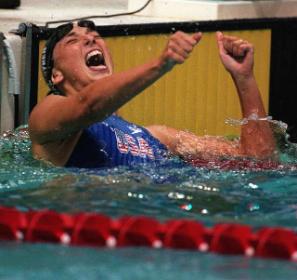
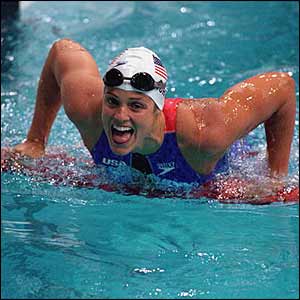
When Amy Van Dyken was in high school, her swimming teammates teased her.  They said she swam so slowly that they did not want her on their team anymore.  Other students made fun of Van Dyken because she was so tall and acted like a “nerd.” In addition to the teasing, she also suffered from asthma, a disease that made it so hard for her to breathe that she could not even climb stairs. Despite all these obstacles, Van Dyken kept swimming. Soon she was so good that she became the star of her team.  In July 1996, at the Summer Olympics in Atlanta, Georgia, Van Dyken swam into the record books by becoming the first American woman to win four gold medals in one Olympic Games.

9. Natalie Coughlin

Medals: 3 Gold; 4 Silver; 4 Bronze = 35 points


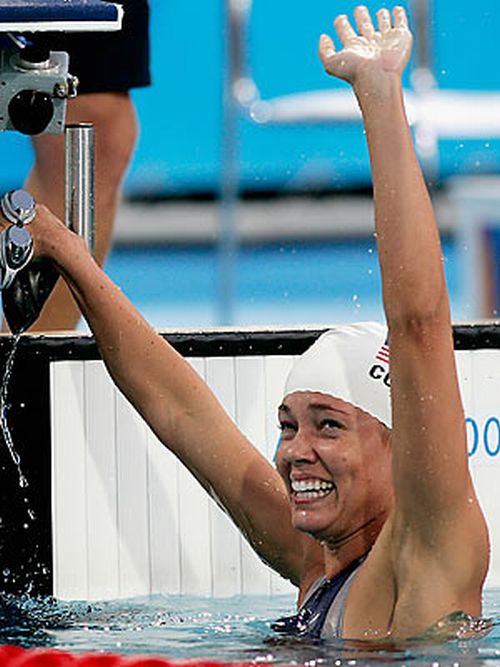
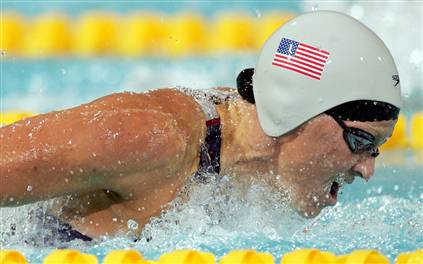
Natalie Coughlin burst onto the international swim scene at the 2001 World Championships, winning a gold medal in the 100 backstroke and a bronze in the 50 backstroke.  In 2002 at the Pan-Pacifics, she was more dominant, winning six medals, four gold with three individual championships in the 100-free, 100-fly, and 100-back.  Coughlin was an early favorite for the 2004 Olympics, but her performance in 2003, and especially at the World Championships, was unimpressive.  There she won only two relay medals, although it was later revealed that she was quite sick and had considered not competing.  Although somewhat overshadowed by the media attention given Michael Phelps, Coughlin was the top female swimmer at the 2004 Olympic Games, winning five medals, including two gold.  Individually, she won the 100 meter backstroke and finished third in the 100 freestyle.  She won her second gold medal in the 800 meter freestyle relay and added two silvers as a member of the United States’ teams in the other relays.

Coughlin continued after 2004 and won a 4×200 freestyle relay gold medal at the 2005 World Championships.  In 2007, she won the 100-backstroke and 200-freestyle at the Worlds, adding a gold medal in the 4×2 free relay. In Beijing, she was again eclipsed by the frenzy that surrounded American swimmers Michael Phelps and Dara Torres.  But she competed in six events, winning a medal in all of them, highlighted by an individual gold medal in the 100 backstroke, becoming the first woman to defend that Olympic title. In two Olympics, she competed in 11 events and won 11 medals, three gold.

8. Polina Astakhova

Medals: 5 Gold, 2 Silver, 3 Bronze = 37 points

For number eight on our list, we have a tie between two great female athletes, Polina Astakhova and Raisa Smetanina.   Polina Astakhova won team gold medals at the 1956, 1960 and 1964 Olympic Games, a feat that she shares with Larisa Latynina, making them the only gymnasts to be members of three gold-medal winning teams. Astakhova also won gold on the uneven parallel bars and placed third in the individual all-around in both 1960 and 1964.  She added silver medals in both 1960 and 1964 in the floor exercises, and her final Olympic tally included 10 medals, five gold, three silver, and two bronze.  At the world championships she was less successful, but was a member of the Soviet Union team that won the team title in both 1958 and 1962.

8. Raisa Smetanina

Medals:  4 Gold; 5 Silver; 1 Bronze = 37 points


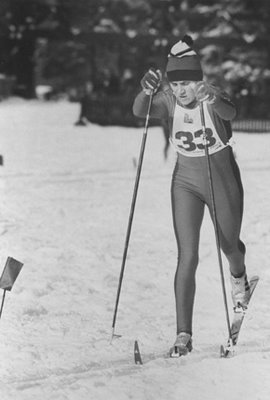
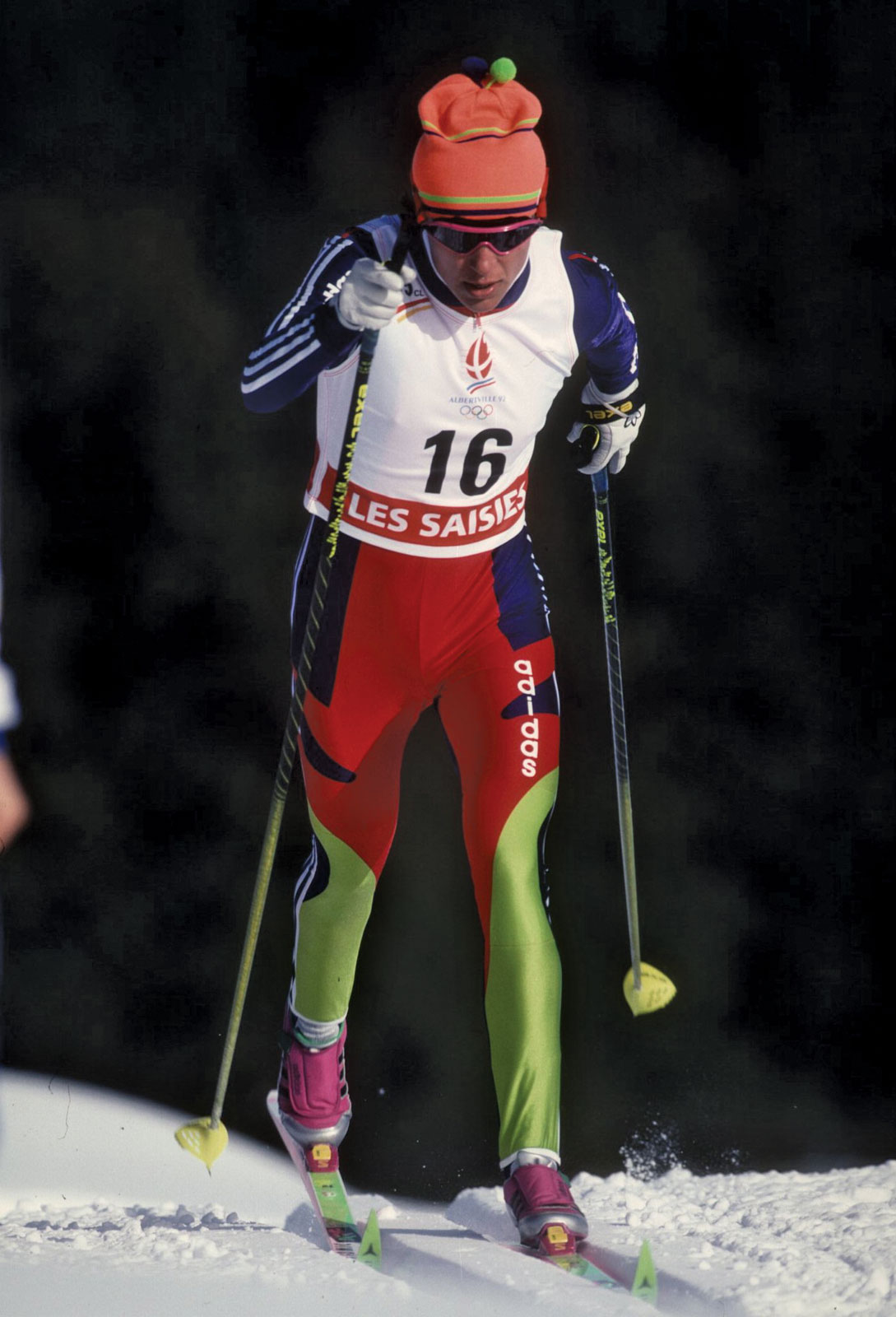
Over a long career that encompassed five Olympics, Raisa Smetanina compiled one of the greatest records of any female cross-country skier. She grew up in an area near the Ural Mountains called Komi, where she learned to ski in the frigid winters.  A loner, she grew up as an only child, and remained single throughout her long career, focusing almost exclusively on her skiing.  She began skiing in 1967 and was first named to the Soviet national team in 1972.  Smetanina first came to international attention at the 1974 World Championships where she finished first in the 5-kilometer and helped the Soviet Union relay team to win the championship.  This led to her greatest Olympic performance at Innsbruck in 1976.  She competed in three events, medaling in all three, with silver in 5 kilometers; and gold in the 10-kilometer and the relay.

Smetanina competed at the Olympic Winter Games in 1976, 1980, 1984, 1988, and 1992, retiring after the Albertville Olympics. During that time, she won 10 Olympic medals, including four gold.  Two of the gold medals came in 1976, and she added another individual gold in the 1980 5-kilometer.
Smetanina’s Olympic career ended when she helped the Soviet women’s relay team to a gold at the 1992 Winter Olympics.  Her gold medal in the relay came only 12 days before her fortieth birthday, making her the oldest female gold medalist in Olympic Winter history.

Raisa Smetanina also won 13 medals at the World Championships. Of these, three were gold medals, including relay titles with the Soviet Union team in 1974 and 1985.  Her only individual world title came in the 20-kilometer in 1982.  In addition to her international triumphs, Smetanina was 21 times champion of the Soviet Union and was named an Emeritus Master of Sport of the USSR.  Smetanina grew up skiing in the classical Nordic style, and never adjusted well to the skating technique which was popularized in the early 1980’s.  She stubbornly refused to learn the skating style and thereafter her competition was confined to the shorter classical style races.

7. Agnes Keleti

Medals: 5 Gold; 3 Silver; 2 Bronze = 38 points


Agnes Keleti is the greatest gymnast ever produced by Hungary.  She first became interested in gymnastics shortly before World War II and her training began at the well-known Jewish VAC Club of Budapest.  She quickly became a top young gymnast, but her career was interrupted by World War II.  During the war her father was removed to Auschwitz, where he was killed by the Nazis.  Agnes Keleti and the rest of her family survived by finding refuge in a “Swedish House” administered by Raoul Wallenberg, who became quite famous for assisting Jews to escape from concentration camps.

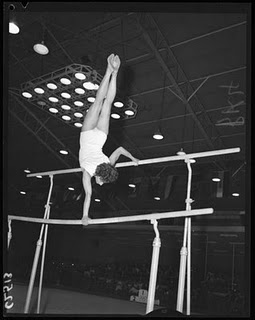
After World War II, Keleti returned to gymnastics and won her first Hungarian championship in 1946, on the uneven parallel bars.  In 1947, she made her first international impact when she dominated the Central European Gymnastics Championships.  She initially earned her living as a fur worker, but she was later a demonstrator at the Faculty of Gymnastics of the Budapest School for Physical Culture.  Keleti was also an accomplished professional musician playing the cello. After serving as an alternate in 1948, Keleti competed in the 1952 and 1956 Olympic Games, at which she won 10 medals, including five gold.  At the 1954 World Gymnastics Championships she won the uneven parallel bars, for her only individual world title.  She was also on the winning Hungarian team in the team portable apparatus event.  Keleti won four medals at the 1952 Olympics in Helsinki, including gold on the floor exercises.  Her greatest gymnastics feats came at the 1956 Melbourne Olympics when she won six medals, including four gold.  In the individual apparatus finals she won the balance beam, floor exercises, and the uneven parallel bars.  She had a poor performance on the vault where she placed twenty-third and the all-around individual gold finishing second to the Soviet Union’s Larisa Latynina.  Keleti also won gold as part of the Hungarian team in the portable apparatus event.

Despite her success in Melbourne, politics again interceded in her career.  In late October, Israel invaded Egypt’s Sinai Peninsula, and then shortly before the 1956 Olympics, on 4 November 1956, Soviet tanks entered Budapest to quell an uprising there.  The two events led to a small boycott of the Olympics.  Although Hungary competed, many of its athletes defected, and Keleti was among them.  She stayed in Australia and then settled in Israel, where she taught physical education at the Orde Wingate Institute and later became the national women’s gymnastics coach.

6. Lyubov Yegorova

Medals: 6 Gold; 3 Silver = 39 points


Lyubov Yegorova is the most successful female Winter Olympian.  Only one person has won more Olympic Winter titles than Yegorova and he was also a cross country skier named Bjorn Daehlie.

Yegorova dominated the women’s cross country events at both the 1992 and 1994 Olympics, medalling in nine of the 10 events held. She was also successful at the World Championships, winning two titles in 1991, and four medals overall including a relay title in 1993.  In 1994 she also won the prestigious Holmenkollen medal.

After an absence in which she became a mother, she returned with her fourth world title in Trondheim at the 1997 World Championships.  However, a few days after her victory, she was found to have used the illegal substance Bromantan and Yegorova was subsequently stripped of her title and banned from competition for two years.  She returned to competition after two years, but was unable to reach her previous successes though she managed to place fifth in the Salt Lake 10-kilometer race.

5. Dara Torres

Medals: 4 Gold; 4 Silver; 4 Bronze = 40 points


Dara Torres has had the longest successful career of any Olympic swimmer, one which has seen her win 12 Olympic medals and four gold. Torres began her career in 1984, winning a gold medal in the 4 x 100 freestyle relay.  She added a silver and bronze in relays in 1988, and seemingly ended her swimming career with another gold in the 4 x 100 freestyle relay in 1992.  Tall and strikingly attractive, Torres then began a career as a model, becoming the first athlete to appear in the Sports Illustrated swimsuit issue.  She also achieved notice as a commercial spokeswoman on an infomercial for a fitness training method, but in late 1998, she elected to return to competitive swimming.  With little time to prepare, she returned to the Olympic pool at Sydney, and won five medals, including two gold in relays.  She won three individual bronze medals at Sydney one in the 50-meter freestyle, the 100-meter freestyle, and the 100-meter fly.

Again retiring after the 2000 Olympics, Torres did not compete in Athens. But in 2006 she began training to make another Olympic team and made the US team for Beijing, winning the Olympic Trials in both the 50 and 100 meter freestyle.  But she elected to compete in Beijing only in the 50 and the 4×100 freestyles and medley relays.  Aged 41, the oldest ever female Olympic swimmer, Torres won a silver medal in the 50-meter freestyle, a race in which she was lost the gold by only 1/100th of a second.  She added silver medals in both relays.  Torres finished her Olympic career lacking only an individual gold medal.  She has won four medals of each color, one of only two Olympians to have won four or more medals of each type (Takashi Ono of Japan in gymnastics is the other).

4. Vera Cáslavská

Medals: 7 Gold; 4 Silver = 47 points


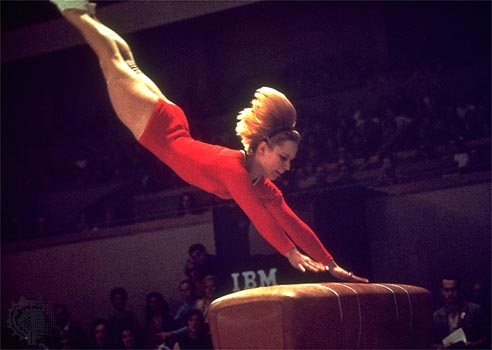
Attractive, vivacious and talented, Vera Cáslavská of Czechoslovakia was the outstanding gymnast at the 1964 and 1968 Games.  In Tokyo she won three gold medals and a silver, winning the all-around on the balance beam and the horse vault, and finishing second in the team event.  In 1968 at Mexico she dominated, winning four golds (one shared) and two silvers. Her 1968 golds came in the individual all-around, floor exercises, horse vault, and uneven parallel bars.  Cáslavská also won a silver medal in the team event in 1960, giving her a total of 11 Olympic medals, which has only been accomplished by Larisa Latynina (USSR) among female gymnasts.

After winning her final gold medal in 1968 she married Czech Olympic silver medalist (1,500 meters in 1964) Josef Odložil (1938-1993), in Mexico. Her victories at Mexico City were dramatic, given the political tenor of the times.  She defeated Soviet gymnasts shortly after Soviet tanks had invaded her homeland of Czechoslovakia.  At the World Championships, Cáslavská won the 1966 all-around, and the vault in both 1962 and 1966. She was all-around European champion in 1965 and 1967, and in 1965, she won the title in all five individual events.  In 1989, Cáslavská was appointed President of the Czech Olympic Committee, and in 1995 she was elected as a member of the International Olympic Committee.

3. Jenny Thompson

Medals: 8 Gold; 3 Silver; 1 Bronze = 51 points


With 12 medals and eight gold medals, Jenny Thompson has won more swimming medals and gold medals than any woman in Olympic history. But all eight of her gold medals came in relays and this immensely talented swimmer was frustrated in her attempt to win an individual Olympic gold medal.  Her only individual medals were a silver in the 1992 100-meter freestyle and a bronze in the same event in 2000.

While attending medical school, Thompson came out of retirement and made the 2004 Olympic team and won two silver for relays in Athens.  Twenty-three times a national champion, she was more successful individually at the World Championships, winning the 100-meter free and 100-meter fly at the 1998 worlds.  At another major international event, the Pan-Pacifics, Thompson also won the 50-meter freestyle four times (1989, 1991, 1993, 1999), the 100-meter freestyle four times (1993-99), and the 100-meter fly three times (1993, 1997-1999).  Among all female Olympians, Thompson’s eight gold medals are surpassed only by Larisa Latynina’s nine in gymnastics, and equaled by Birgit Schmidt-Fischer in canoeing.  Thompson has since become a physician.

2. Birgit Schmidt-Fischer

Medals: 8 Gold; 4 Silver = 52 points


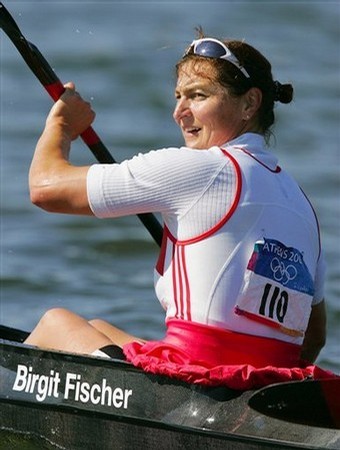
Birgit Schmidt-Fischer of Germany (formerly East Germany) is considered the greatest female canoeist of all time.  Her total of 37 medals (1979-2005) and 27 gold medals (1979-1998) at the World Championships has never been approached and her 12 Olympic medals and eight gold medals are also records.  Representing East Germany (GDR) she won the Olympic K1 title in 1980 (as Miss Fischer) and the K2 and K4 in 1988. After a three-year break from competition, during which she gave birth to her second child, she won the K1 in 1992 as a member of the unified German team.

In 1996 at Atlanta, she paddled with the German K4 team to win her fifth gold medal, and at Sydney in 2000, she added two gold in both K2 and K4.  Her husband, Jörg Schmidt, was a World Champion and Olympic silver medalist (in the C1-1,000 in 1988).  Birgit Fischer initially retired after the 2000 Olympic Games, but returned in 2003 and competed in the 2004 Olympic Games, winning a gold and silver medal.  She has now won gold medals at six different Olympic Games spanning 24 years.  Schmidt-Fischer also won two medals at the 2005 World Championships.

1. Larisa Latynina

Medals: 9 Gold; 5 Silver; 4 Bronze = 88 points


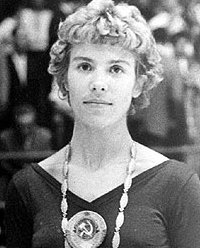
The Soviet gymnast, Larisa Latynina, holds the distinction of having won the most medals of any athlete (male or female) in Olympic history. Between 1956 and 1964 she won medals in 18 gymnastics events, as follows: Gold (9) – 1956 all-around, 1956 floor exercises, 1956 vault, 1956 team, 1960 all-around, 1960 floor exercises, 1960 team, 1964 floor exercises, and 1964 team; Silver (5) – 1956 uneven parallel bars, 1960 balance beam, 1960 uneven parallel bars, 1964 all-around, and 1964 horse vault; and Bronze (4) – 1956 team portable apparatus, 1960 horse vault, 1964 balance beam, and 1964 uneven parallel bars.

She failed to medal only in the 1956 balance beam in which she finished with a tie for fourth.  She also won six titles at the 1958 and 1962 World Championships in individual events.  At the 1957 European Championships, Latynina won all five individual events – all-around and the four apparatus finals.  After her retirement from competition she became the national gymnastics team coach.